
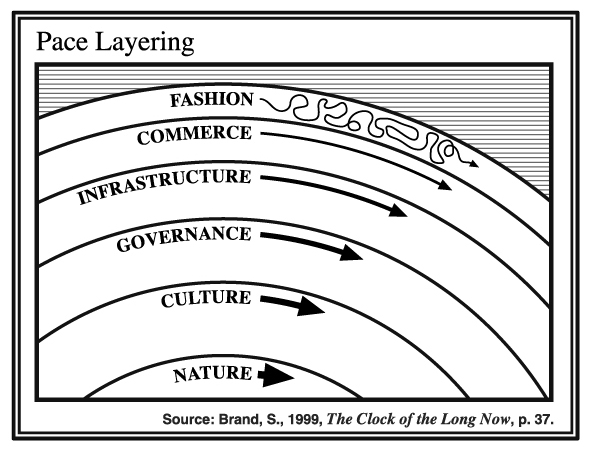

Product includes devices like XBox, TiVo, and PalmPilot; apps like Firefox, MS Office, and Lotus 1-2-3; and services like Google, Facebook, and Wikipedia.
Components include libraries and frameworks: glibc, LLVM, Django, React, Docker, Arduino, etc.
Organizations involve some form of human governance, eg companies like Bell Labs, IBM, Microsoft, and ARM; non-profits like ICANN, the FSF, and the Linux and Apache foundations; and standards bodies like IETF, W3C, ECMA, and OASIS.
Standards are open via standards bodies, proprietary to individual companies, and de facto. Examples include networking protocols like TCP/IP, HTTP, and SMTP; file formats like HTML, JPEG, and WAV; character encodings like ASCII, ISO 8859-1, and Unicode; operating system interfaces like Win32, POSIX, and Cocoa; and hardware languages like Verilog, VHDL, CUDA, FPGAs, etc.
Computer science and electrical engineering are the academic fields that provide the direct foundations for software and hardware, respectively, and math and physics underneath them. Number theory and cryptography, information theory, combinatorics, Boolean logic, digital and analog circuit design, and arguably even materials science processes like EUV lithography all live here.
I’m far from the first to think along these lines. Erik Samsoe on Twitter (with Brand himself), Dmitri Glazkov’s Forces of the pace layering confusion, and Gartner’s Pace-layered Application Strategy. Taking a wider view, the classic 7-layer ISO network model and 4-layer IETF model are a form of pace layering applied to networking protocols.














































At first I didn’t understand the ‘organisations’ level, but then I realised that they just had the wrong place in your structure for me. Science is initially unstructured and organisations then bring in the structure that leads to standards.
@jessmart.in didn’t you have a version of this?
I found this note of yours, but I thought you did a talk about this
notes.jessmart.in/Lab+Notebook…
It was also depicted in bigmedium.com/ideas/design… to discuss the difference between platform/infraestructure and product teams within the context of Design Systems.
More Pace Layering for you Ryan, from Steven Johnson:
adjacentpossible.substack.com/p/how-to-rea…
Pingback: What I have been reading recently | James' Coffee Blog